
The Promise We Remember
Around twenty-five years ago, nanotechnology seemed to be one of those technologies that could transform people’s lives. It was discussed everywhere — in medicine, computing, manufacturing and several other areas — but the one application that caught my attention was cancer treatment.
The idea sounded almost magical.
Cancer treatment, particularly chemotherapy, could be extremely harsh because while it attacked cancer cells, healthy cells could also get caught in the crossfire. Nanotechnology seemed to offer a very different future. The promise was that extremely tiny particles could carry medicines through the bloodstream and deliver them much more precisely to the tumour, reducing the damage to the rest of the body.
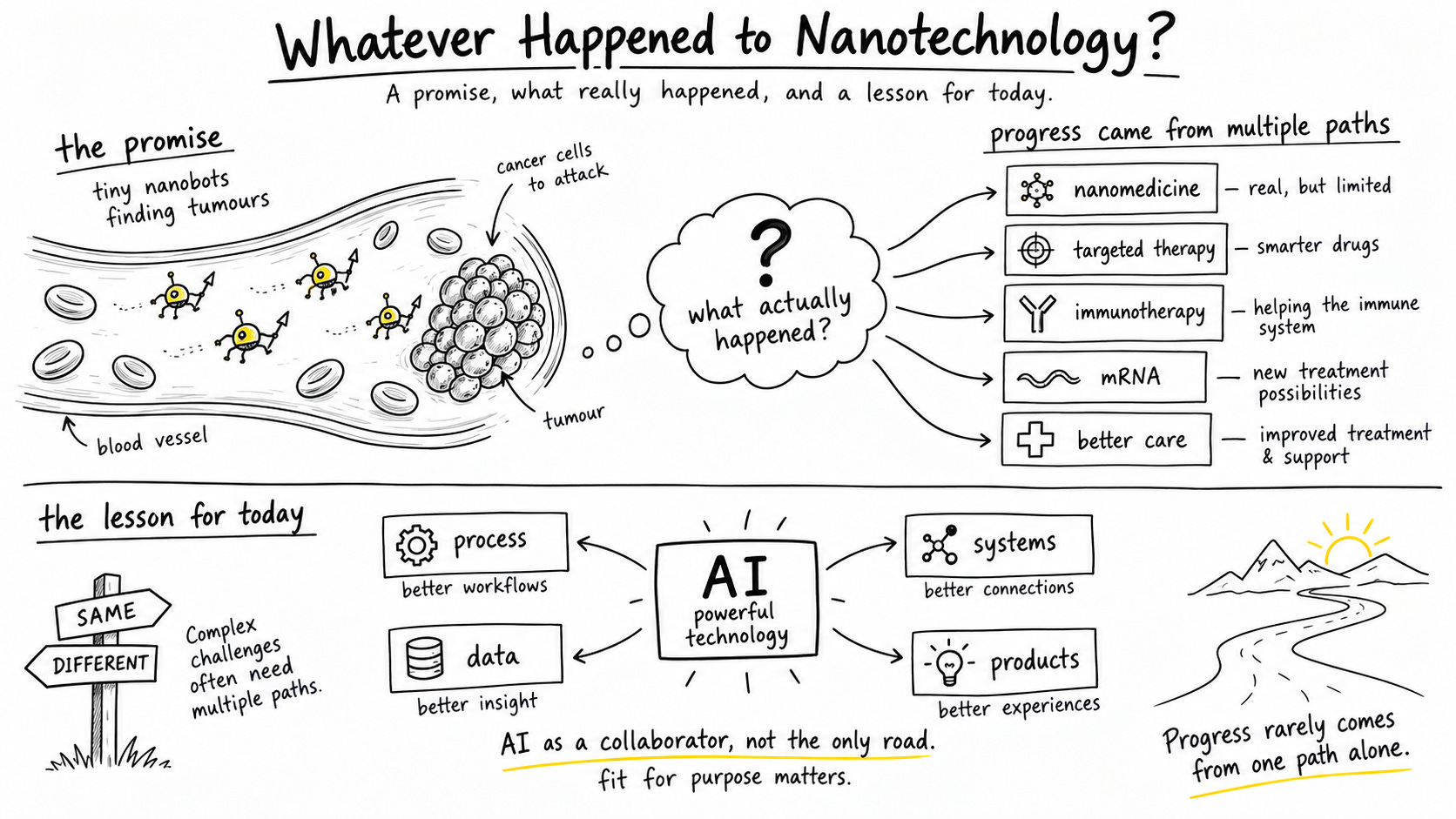
And for someone like me who knew practically nothing about biology, the imagination went much further than the science probably intended. I used to picture millions of tiny nanobots floating through the bloodstream — for some inexplicable reason, they were yellow in my imagination — finding the cancer cells and attacking them with tiny spears!
It sounds funny now, but the larger expectation was not something I had invented. Around the turn of the millennium, governments and research institutions were themselves talking about nanotechnology detecting cancers when they were extremely small and making treatment much more precise. In 2000, the US government was publicly discussing a future in which nanotechnology might detect and treat tumours when they were only a few cells in size, while reducing the severe side effects of cancer treatment. By 2004, the US National Nanotechnology Initiative was discussing cancer treatments using nanostructures that could seek out malignant cells while reducing damage to surrounding healthy tissue.
So this was not merely science fiction. There was serious science behind it, and there was genuine optimism about where that science could lead.
For many years, I assumed this was one of those technologies that would gradually move from research laboratories into mainstream medicine. Yet, as the years passed, the word “nanotechnology” itself seemed to become much less visible. We continued hearing about advances in cancer treatment, but rarely in the dramatic language that surrounded nanotechnology in the late 1990s and early 2000s.
That made me wonder what had actually happened. Was the technology overpromised? Did the science fail to progress? Or did it quietly succeed in ways that were simply less spectacular than what many of us had imagined?
The answer, as I discovered, lies somewhere in between.
What Actually Arrived
Nanotechnology did make its way into medicine.
There are cancer drugs today that use very small carriers to package or transport medicines through the body. Doxil and Abraxane are two well-known examples. These approaches can change how a drug circulates, improve how it is delivered and, in some situations, reduce particular side effects. They are real treatments that are already used in clinical practice.
What did not arrive in the same way was the more ambitious picture many of us had in our heads — tiny intelligent machines travelling through our bloodstream, locating cancer cells with extraordinary precision and delivering treatment almost exclusively to them.
The progress was useful, but much more incremental than the imagination around nanotechnology had suggested.
There was another success that surprised me even more because I had never really associated it with nanotechnology.
The mRNA vaccines used during the COVID-19 pandemic relied on tiny lipid particles to protect the fragile mRNA and help deliver it into cells. The science behind these lipid nanoparticles did not suddenly appear during COVID. It was the result of decades of research, with a recent review tracing the development of these delivery systems over roughly sixty years.
Most of us never thought of this as nanotechnology. We simply called it a vaccine.
Perhaps this explains part of the mystery surrounding nanotechnology. Once a technology becomes useful enough to disappear inside a product, we stop talking about the technology itself. We do not say that we are receiving nanoscale drug-delivery technology. We say that we are receiving treatment.
In that sense, nanotechnology did not disappear. Some of it simply became invisible.
Why the Original Vision Was So Difficult
Even after giving nanotechnology full credit for what it achieved, the original ambition in cancer treatment remains only partly fulfilled.
The idea appeared straightforward when viewed from the outside. Put the medicine inside a very small carrier, inject it into the bloodstream, allow it to travel to the tumour and release the medicine there rather than everywhere else.
Unfortunately, the human body had other ideas.
Once these particles enter the bloodstream, they have to survive the body’s natural filtering and defence mechanisms. Organs such as the liver and spleen are designed to remove things that do not belong there, and a large proportion of nanoparticles may get captured before they reach the tumour. Even particles that reach the tumour face additional barriers because tumours themselves are not neat, uniform structures.
This is where the gap between the idea and reality becomes quite striking. Large reviews of nanoparticle research have found that, typically, well below one percent of an injected nanoparticle dose reaches a solid tumour. The exact significance of that number is debated — very small quantities can sometimes still produce therapeutic benefits — but it illustrates how much harder targeted delivery turned out to be than the simple picture suggests.
Some of the early experiments, particularly those using animal models, produced excellent results. Human cancers proved far more complicated. Researchers became increasingly good at creating sophisticated nanoparticles, but making them behave predictably after entering the human body was a completely different challenge. Reviews of the field have themselves pointed out that models that worked very well for demonstrating success in mice were often less useful for predicting what would happen in humans.
There were practical issues too. A treatment that works beautifully in a laboratory has to be manufactured consistently in large quantities. It has to remain stable, go through clinical trials, satisfy regulators and eventually reach patients at a cost healthcare systems can support.
So I do not think it is fair to say that nanotechnology failed. It produced genuine scientific and medical advances. But it is equally difficult to say that it transformed cancer treatment in the way people imagined twenty-five years ago.
Progress happened, but it happened more slowly, with more limited capabilities and in less spectacular ways than the early promise suggested.
Cancer Treatment Took Other Paths
This is where the story becomes far more interesting to me.
While scientists were trying to improve the precision with which medicines could be delivered, cancer treatment did not sit around waiting for nanotechnology to solve everything.
It started progressing through other approaches.
One of those was targeted therapy. Rather than concentrating entirely on how a drug could be physically carried to a tumour, researchers began identifying particular characteristics that some cancer cells depend on and developing medicines that attack those specific targets. This has now become an important part of modern cancer treatment and precision medicine.
Immunotherapy opened another path. Instead of directly attacking the cancer using a conventional drug, some treatments help the body’s own immune system recognize and fight the cancer more effectively. Several forms of immunotherapy are now used across different cancers, although they do not work for every patient or every cancer.
Chemotherapy itself has improved as well. It can still be extremely difficult, and it would be wrong to suggest that its side effects have disappeared. But doctors have become better at managing those effects, choosing treatment combinations and tailoring treatment more carefully.
Our understanding of cancer has also changed. Increasingly, doctors are not looking only at where the cancer appears in the body. They are also examining the specific characteristics of that cancer and using that information to decide which treatments might work best.
And new approaches continue to emerge. Researchers are exploring mRNA-based cancer treatments, including personalized cancer vaccines designed to help the immune system recognize features of an individual’s tumour.
The overall picture is still far from perfect, and some cancers remain extremely difficult to treat. But progress is real. In the United States, for example, the overall cancer death rate has been declining since the early 1990s, with improvements in prevention, diagnosis and treatment all contributing to that trend.
What I find fascinating is how this progress happened.
Twenty-five years ago, one exciting possibility was to make drug delivery dramatically more precise through nanotechnology. Nanotechnology did contribute to that journey, but medicine also found several other ways to pursue the same broader objective — targeted drugs, immunotherapy, better diagnosis, better understanding of cancer biology and improved treatment practices.
Medicine did not stop exploring one approach because another looked promising. It kept progressing on several fronts at the same time. That, to me, is the most interesting part of this entire story.
Which Brings Me to AI
It is difficult today to have any serious conversation about technology without artificial intelligence entering the discussion.
I am certainly not cynical about AI. In fact, I love what the technology can already do.
The research behind this very article is a good example. Without AI, researching a subject like this would have meant finding the right websites and research papers myself, reading through them one by one, trying to understand unfamiliar medical terminology, making notes, comparing different views, revisiting earlier material and eventually trying to discover the pattern hidden inside all that information.
AI has reduced that effort significantly — probably by an order of ten, and in some situations perhaps even a hundred.
That is phenomenal technology. At the same time, I did not want to simply accept whatever AI gave me. The claims in this article were checked against research papers, government publications and established medical sources. AI helped me find, compare and understand the material much faster, but the underlying sources still mattered.
And this is only one personal example. AI can already help people write software, analyse documents, summarize information, perform research, generate ideas and automate several parts of knowledge work. There is little doubt in my mind that these capabilities will continue to improve.
My concern therefore is not about AI itself. It is about what happens when one technology becomes so dominant in our thinking that almost every problem begins to acquire an AI solution.
Across customer service, software development, finance, sales, HR and operations, AI is increasingly becoming part of almost every improvement discussion.
Many of these applications make complete sense. Some will probably create enormous value.
But the nanotechnology story makes me wonder whether we should also keep looking sideways.
I should also be clear that AI and nanotechnology are not equivalent technologies. AI is much broader in its possible applications and can participate in improvements across almost every part of an enterprise. In some ways, that makes the question of fit even more important. When a technology can potentially be applied everywhere, the temptation is to assume that it should be applied everywhere.
AI as a Collaborator, Not the Only Road
An enterprise can improve in many ways — by fixing a badly designed process, modernizing an ageing system, improving data quality, integrating applications better, simplifying approvals or automating predictable work using conventional software.
AI can strengthen many of these improvements. It can help analyse processes, identify patterns, generate code, review designs and help teams move faster. In such cases, AI becomes a collaborator in the improvement rather than the improvement itself.
That is why fit for purpose matters. Not every problem becomes better simply because AI is added to it. Sometimes AI will be exactly the right tool. Sometimes a workflow, a rule, an integration or conventional automation will be the better answer.
Instead of starting with, “Where can we use AI?”, perhaps we should first ask, “What exactly are we trying to improve, and what is the most appropriate way to improve it?”
Cancer research offers a useful reminder. Nanotechnology continued to advance, but so did targeted medicines, immunotherapy, diagnostics and other approaches. Progress came from several directions at the same time.
Enterprises may need to think about AI in much the same way.
Twenty-five years from now, AI may have transformed organizations far beyond what we can imagine today. But some of the most valuable improvements may also come from less fashionable places.
That would not mean AI failed, any more than targeted therapies and immunotherapy mean nanotechnology failed.
So, whatever happened to nanotechnology?
Quite a lot, actually.
Just not everything we expected.
And perhaps that is the useful reminder for the AI age: back the breakthrough, but never stop looking for the other ways forward.