
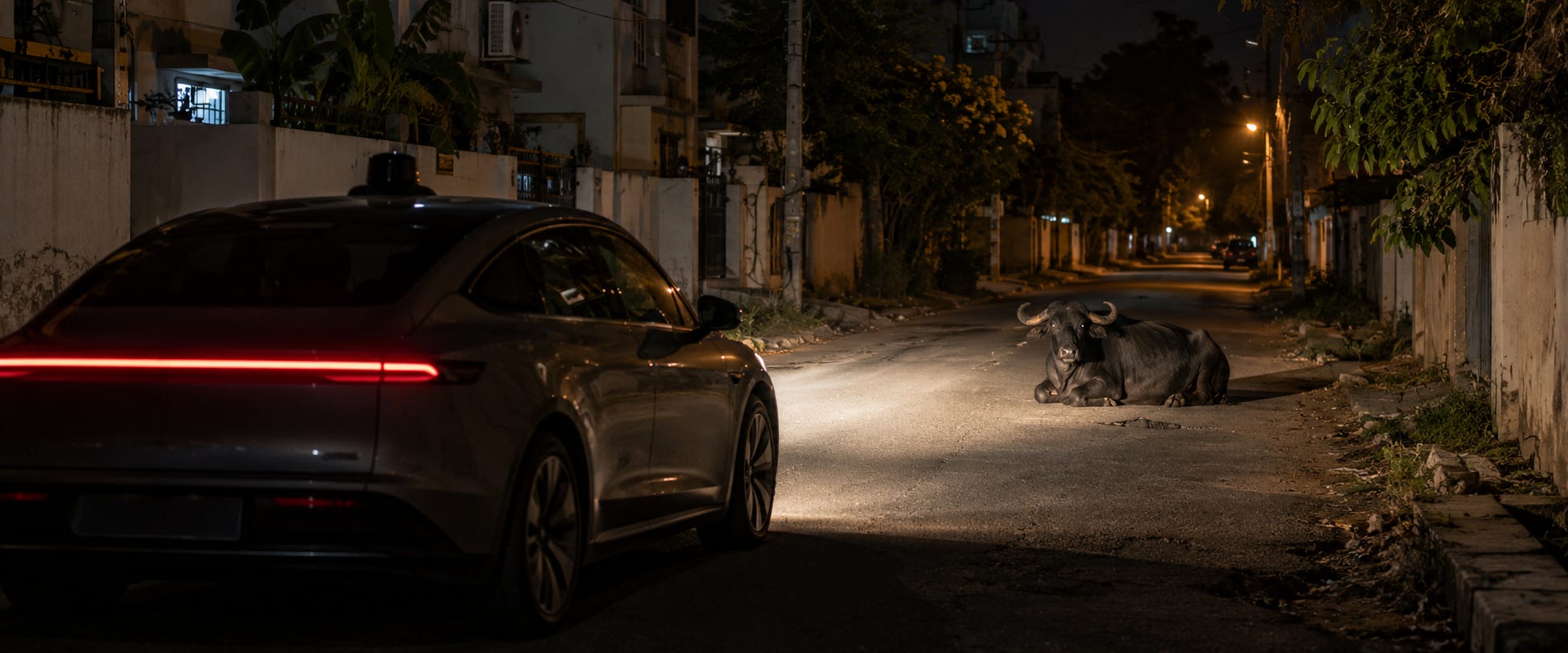
I live in Manapakkam. It is part of Chennai, or possibly Kanchipuram district. I have never been fully sure. It is a city when tax is collected and a village when cows block the road.
Most mornings I drop my daughter at school. She believes that since Appa is driving, time itself will adjust. She starts late, walks slowly, remembers forgotten things at the last minute, and has more or less outsourced urgency to me.
The first obstacle is the street dogs near our gate. One of them opens an eye, looks at the car, and closes it again. The message is clear enough: go around, citizen.
After that, luck takes over.
The cows come in every colour, and they do not so much cross the road as occupy it. One will decide that this is the moment, with no indicator and no eye contact, and drift slowly to the other side. You brake. Someone behind you honks, a full and personal honk, as though I am an idiot who decided to stop the car in the middle of the road for fun. He overtakes, and finds the same cow now standing in front of him. This happens almost every day. The lesson never seems to spread.
Potholes work the same way. You slow down for one, the person behind you honks, overtakes, and meets it. I have watched two-wheelers wobble and occasionally fall, and I am ashamed to admit that a small voice in me says, “Justice served.”
Then there are the buffaloes, which is a different matter. A cow drifts. A buffalo holds position. If you are the unlucky car directly behind one, everyone behind you behaves as if you are the only traffic cop available to regulate the buffalo. They honk at you, as though the buffalo is waiting for your instruction.
This is how we drive in Manapakkam. Not by rules exactly, but by prediction. That auto is leaning left but the driver is looking right, so he will probably stop in the middle. That cow is standing still, which means it may move now, or after lunch. Every driver here is running a small artificial intelligence in his head, and it has been trained entirely on fear.
Now put a Tesla in this.
In America the algorithm handles lanes, pedestrians, signals and the occasional deer when the car is driving through areas where deer may cross. Here that is the kindergarten syllabus. Before the car has moved ten feet, it must decide whether that is a cow or a buffalo, or a dog sitting under a cow, or a buffalo behind an auto, visible only as two horns and one suspicious eye.
Many new cars in India already come with ADAS, which beeps like a nervous passenger. But ADAS assists. A driverless car has to decide what danger means, and here danger arrives in layers. A cow standing in the middle of the road is one layer. A cow hidden behind a share auto and suddenly ready to cross is another. A herd of buffaloes is a full project plan: just when you think you have negotiated one, the next one appears.
Night is harder. Many of our streetlights are absent, not working, or so dim that they are technically present but emotionally unavailable. The road is dark, the pothole is dark, and the sleeping buffalo is dark. Then two eyes appear in the middle of the road, with no body and no legs.
This is where the Tesla would panic.
The screen would not calmly say “Please take over.” It would behave like a system that has seen something it was not trained for:
Object detected.
Classification failed.
Distance uncertain.
Road edge uncertain.
Large mass suspected.
Emergency braking.
Autonomous driving suspended.
Human driver required immediately.
And somewhere behind you, a bike honks. Even now. Even though the buffalo is invisible.
But the chaos is not random. It has an internal logic, which every local driver learns slowly through fear, irritation and daily survival. We are impulsive, improvising people, and the road reflects us back at full volume. We do not move in straight lines. We move in possibilities. A two-wheeler does not see a gap; he imagines one.
This is why the rules are the easy part. A system can learn those. What it must also learn are the exceptions, then the exceptions to the exceptions, then the ones invented on the spot by one auto driver, two school parents, three cows, a pothole and a bike coming from the wrong side. Normal AI predicts behaviour. Indian road AI has to predict the behaviour of people who do not know what they will do next. The system has to become as chaotic as we are, but with better brakes.
So perhaps we should invite Elon Musk to Manapakkam on a Monday at 8:15 a.m. and ask him to make a Tesla drive here. If it survives without a human taking over, I will gladly pay the premium. I would count that as a spiritual achievement.
It will be ready when it can take me from my apartment to my daughter’s school while she sits in the back seat, completely relaxed, still believing that time will adjust.
If a car can do that without asking for a human, Mars is easy.